


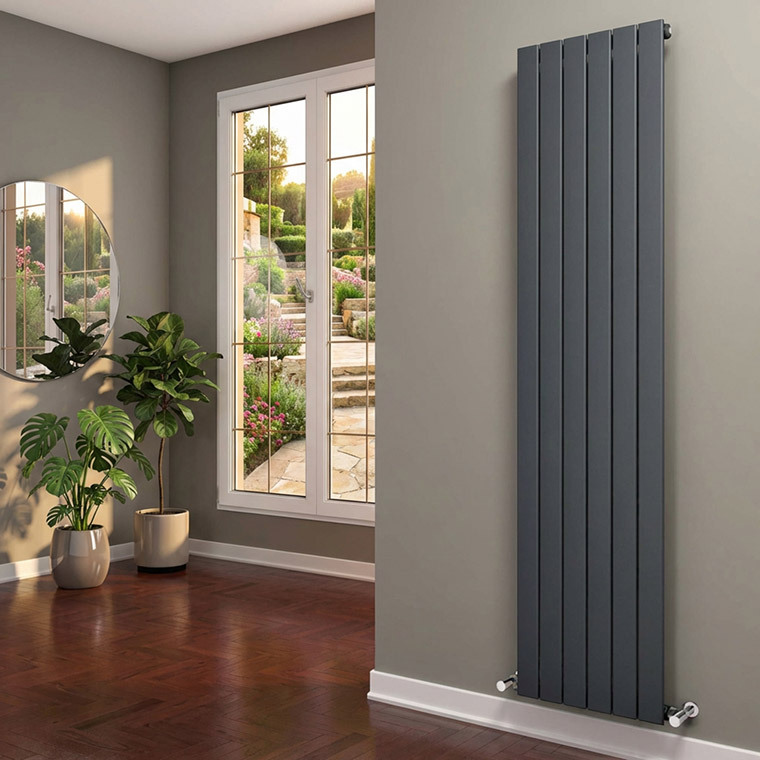

Electric radiators turn electricity into heat for living rooms, bedrooms, home offices and other living spaces. They operate without a connection to heating pipework. You can use a standalone electric radiator whether your home has a boiler, communal heating, a heat pump or underfloor heating.
To choose well, consider the room’s heating needs, whether the radiator will provide main or supplementary heating, the wall space and the electrical connection. This guide explains how to use Radiva’s watt and floor area information, plan installation and calculate consumption.
How It Works
An electric heating element warms the radiator, which releases heat into the room. The element and the way heat reaches the surface can differ by model: an electric glass radiator and a radiator fitted with an electric heating kit do not have the same internal design. Depending on the model, controls provide on/off switching, temperature adjustment or timing.

When It Can Be Useful
| Your need | How an electric radiator helps |
|---|---|
| No heating pipes in the room | Independent heating with a suitable electrical connection |
| Main heating is off | Heat the room you need separately |
| Existing heating is insufficient | Provide supplementary heat |
| Use as the main heater | Choose output that meets the room’s heat loss |
An electric radiator is intended to heat the room. Unless the product manual expressly allows it, do not hang towels or laundry over it or cover its surface, controls or any air openings.
Choose the Right Output for Your Room
Watts and Floor Area in Radiva Product Details
Radiva presents electrical product power in watts and also gives the average floor area a product can heat. Use these figures together to compare models for your room. Refer to the information for the exact electric version, size and electrical configuration you are selecting.
For example, a room measuring 4 by 5 metres has a floor area of 20 m². Compare this with the average area listed for your chosen Radiva model. If it will be the room’s only heater, its output must meet the room’s total heat loss. Supplementary heating capacity depends on the shortfall left by the existing system.
The floor area figure is a starting point. Insulation, ceiling height, glazing, external walls, climate and the target temperature affect the actual requirement. Share details of large windows, high ceilings or a cold room with Radiva. Do not rely on a single watts-per-square-metre rule for every home.
What the Watt Rating Tells You
Watts express the appliance’s power; kWh expresses the electrical energy used over time. Different sizes or electrical configurations of the same model can have different ratings. A lower wattage does not always mean lower total consumption: an undersized heater may run for a long time without reaching the target temperature.
Choose Controls to Suit Your Routine
| Feature | What to check |
|---|---|
| On/off control | How manual operation works |
| Thermostat | Whether it senses room or appliance temperature |
| Timing | Timer or daily schedule options, where fitted |
These functions are not identical across all products. Check whether the thermostat controls room or appliance temperature and which programmes are available. Scheduling heat for the times you need it helps you manage comfort and consumption together.
Plan Mounting and the Electrical Connection
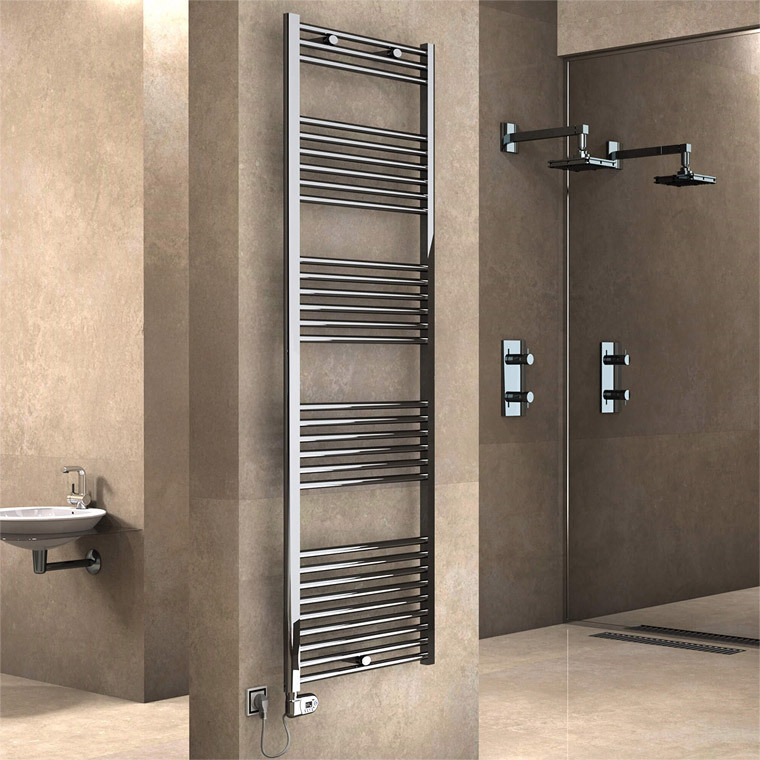
Plug-in Radiva electric radiators can be used after they are securely wall-mounted as instructed and connected to a suitable socket. Connection arrangements vary by model: check whether your chosen product is plug-in or hardwired before ordering. Do not add water, fit a heating kit or alter the connection yourself.

If You Want an Installation with No Visible Cable
Confirm with Radiva that your chosen electric radiator supports a concealed connection. On suitable models, a professional electrician connects a cable prepared in the wall to the product’s connection compartment, leaving no cable visible after installation. Position the wall outlet according to the model’s drawing. Do not assume every plug-in product can be converted to concealed wiring.
Mounting Orientation and Use Instructions
Electric radiators do not all have the same internal design. Install each model only in its specified horizontal or vertical orientation. Where the heating kit must be at the bottom, retain that position: do not use the product upside down or in an unapproved horizontal position. Refer to the product manual for warranty terms covering damage caused by incorrect orientation or installation.
Check wall strength, fixings, cable reach and clearances to furniture. The socket or fixed circuit must be suitable for the appliance’s rating, with electrical protection assessed by a professional. For bathroom use, also confirm that the model is suitable for the room and the intended location.
Does an Electric Radiator Need Matching Pipe Centres?
A standalone electric radiator does not connect to heating pipes, so it does not need to match hydronic pipe centres. The wall fixing positions, product dimensions and electrical connection matter instead. If removing a hydronic radiator, have its pipework properly taken out of service by a heating professional.
Calculate Consumption and Complete Your Choice
Consumption depends on both power and the time the heating element actually runs. Calculate it as watts ÷ 1,000 × hours at full power = consumption in kWh. The 300-watt example below illustrates the calculation; it is not a recommended output for your room.

| Time at full power | Calculated consumption |
|---|---|
| 1 hour | 0.3 kWh |
| 2 hours | 0.6 kWh |
| 4 hours | 1.2 kWh |
A 300-watt appliance running at full power for a total of 2 hours a day uses 18 kWh over 30 days. Multiply consumption by the applicable electricity unit rate to estimate cost. A thermostat may stop and restart heating once the target is reached, so time switched on can differ from time heating at full power. Actual consumption depends on the room and use.
Frequently Asked Questions
Does It Need a Boiler or Communal Heating?
No. It needs a suitable electrical connection and can be used when the main heating is off, including in summer when needed.
Can It Heat a Room on Its Own?
It can be the main heater if its output meets the room’s heat loss. Assess the listed floor area alongside the room’s conditions.
Can Every Hydronic Radiator Be Converted to Electric?
No. Suitability depends on the body design, electrical equipment and installation conditions. Ask Radiva before considering a conversion.
Choose Your Model with Radiva
Radiva’s wide choice of models, sizes and colours helps you find a solution for your space. For a new room, select the right output and model first, then position the electrical outlet to the drawing for greater freedom of choice.
Share the room dimensions, a wall photo, whether you need main or supplementary heating and your preferred model with our live chat. You can get immediate replies at many times throughout the day on radiva.com, or call +90 216 469 8406 during office hours.



